
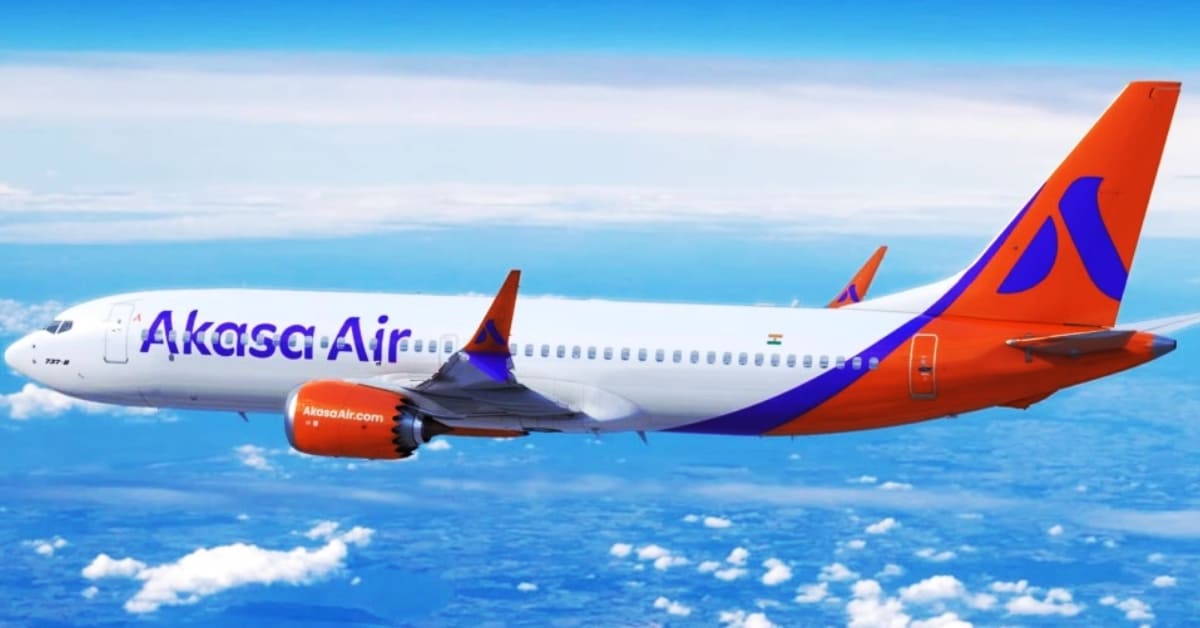
Akasa Air’s Vision: Going Global
Posted on : 9 December, 2025 7:56 pm
Akasa Air has shown tremendous growth in the Indian aviation market since its launch in 2022. However, the airline isn’t looking inwards but is setting its eyes on international horizons. As per recent announcements, Akasa Air plans to extend its network to new destinations in East Africa and the Middle East, marking ambitious growth and a shift toward becoming a global player. The CEO of the airline, Vinay Dube, says, ” Akasa Air is “very good” about its aircraft delivery schedule, a fact that gives confidence to scale up operations-both domestically and internationally.
New Routes on the Radar: Africa, Middle East and Beyond
Akasa Air is considering flights to Kenya, Ethiopia, and Egypt. According to the management of the airline, its jets — particularly the Boeing 737 MAX — are competent at flying over longer distances, which opens up far more possibilities.
In addition, it plans to announce new services to Sharjah.
If these materialize, it would be a significant expansion of Akasa’s international footprint, moving well beyond its current destinations in the Gulf and Southeast Asia.
Current Status: What Akasa Air Already Offers
Currently, Akasa Air flies to several international cities-Doha (Qatar), Jeddah, and Riyadh (Saudi Arabia), Abu Dhabi (UAE), Kuwait City (Kuwait), and Phuket (Thailand ).
Domestically, the airline serves a wide network across many Indian cities, making it one of the fastest-growing carriers in terms of route coverage.
With a current fleet of 30 Boeing 737 MAX aircraft and firm orders for as many as 226 such planes, Akasa Air is well-positioned to expand. The airline expects to add “more than one aircraft” in the near term.
Strategy Behind the Expansion: Fleet, Partnerships & Network
A key enabler of this ambitious expansion is the airline’s modern fleet. Boeing 737 MAX aircraft give Akasa the flexibility and range needed for long-haul international routes.
Akasa Air is also working towards tie-ups, including codeshare and interline agreements, to enhance its international network. For example, on the back of an already-announced partnership with Etihad Airways, such a deal would allow Akasa to feed into far-reaching global networks for more choice and seamless connectivity for travellers.
Also important to note: the airline plans to raise the share of international operations to about 30% of total seat-capacity–Available Seat Kilometres or ASK–by March 2027. This shows long-term intent, not just short-term experiments.
What This Means for Travellers & Indian Aviation
-
More Connectivity, More Options
Should Akasa Air go ahead with its Africa and Gulf expansion, the travellers from India, especially those from cities that do not have direct international connectivity, will gain access to new, affordable options of travel to Africa, the Middle East, and onwards.
-
Better Competition → Better Services & Fares
With more airlines pushing internationally, the competition should continue to drive better pricing, more convenient routes, and improved inflight services. Akasa already offers a modern fleet, and such expansion may eventually drive other carriers to upgrade their offerings.
-
India Becoming an Aviation Hub
Akasa’s expansion epitomises a wider trend: Indian airlines fly not just within the country but are building global networks. That in turn could help to strengthen India’s position as a major aviation hub across continents over time.
-
Benefits Beyond Passengers: Jobs & Industry Growth
More flights mean more demand for pilots, crew, ground staff, maintenance – and more business for airports, support services, travel agencies. In the longer run, this helps in job creation and growth of ancillary aviation industry in India.
Challenges & What to Watch Out For
Of course, international market expansion isn’t easy. Airlines have to manage aircraft delivery schedules, crew hiring, traffic rights, and regulatory clearances, apart from airline partnerships, while also ensuring a high level of service and safety standards. But as far as Akasa leadership is concerned, they sound quite confident about the delivery schedule of their Boeing fleet-a good omen.
Moreover, geopolitical situations, airspace restrictions, or economic changes around the globe might also affect demand for or the viability of routes. The success of new routes, especially to Africa, will depend on travel demand between India and those destinations, and also on how competitive Akasa will be with fares and services.
What to Expect Next from Akasa Air
- Official announcements concerning new routes that may be opened in the coming months to East Africa, Kenya, Ethiopia, Egypt, and Sharjah.
- Gradual ramp-up of fleet, possibly more aircraft deliveries, enabling expansion of both domestic and international services
- More codeshare agreements or interline partnerships with international carriers to offer broader connectivity.
- More frequency and destinations from Indian metro hubs – thus making it much easier for travellers all over India to access these new international routes via Akasa.
Conclusion
Akasa Air’s push into international markets — targeting Africa, Middle East and possibly more regions — marks a major chapter in its growth story. With a modern fleet, firm aircraft orders, and a clear strategy, the airline is betting big on global connectivity.
For travellers, this could translate into more choice, convenience and competitive fares. For Indian aviation as a whole, Akasa’s expansion reflects the industry’s growing maturity and ambition.
In short: Akasa Air is no longer just another low-cost domestic airline. It has its eyes set on the world — and that could reshape how Indians travel abroad in the years ahead.